

If you've shopped for a smell-proof bag, you've probably seen "activated carbon" or "carbon lining" in the spec sheets. What most product pages don't tell you is that "activated carbon" is a category, not a product — and the source material matters more than the marketing.
This is a plain-English breakdown of how activated charcoal works, why coconut-derived charcoal outperforms the alternatives, and what to look for when you're evaluating bags.
How activated charcoal blocks odor
Odor is molecules. When you smell something — coffee, cannabis, gasoline, anything — your nose is detecting volatile organic compound (VOC) molecules in the air.
Activated charcoal works through a process called adsorption (not absorption — there's a difference). Adsorption means molecules physically stick to the surface of the charcoal. Activated charcoal has an enormous internal surface area thanks to billions of microscopic pores per gram. When odor molecules pass through the charcoal-lined material, they bind to those pore surfaces and stop moving.
The math: a single gram of high-quality activated charcoal can have a surface area of 3,000-3,200 square meters. That's about three-quarters of a football field, packed into a gram.
The more surface area, the more odor molecules can be trapped. The longer the bag stays smell-proof.
Why the source material matters
"Activated charcoal" can come from a few different source materials. The most common in commercial use are:
- Coconut shell — what we use in Executive Tech bags
- Bituminous coal — common in industrial filters
- Wood / sawdust — common in cheaper aquarium filters
- Petroleum residues — used in some industrial applications
The internal pore structure varies dramatically by source. Coconut-derived charcoal has the highest density of micropores (pores smaller than 2 nanometers), which is exactly the size range that traps small VOC molecules — including the terpene molecules that produce most cannabis odors.
Bituminous coal charcoal has more macropores (pores larger than 50 nanometers), which is better for trapping large industrial pollutants but worse for fine odor molecules.
Wood charcoal is cheap but has less consistent pore structure and generally lower surface area.
In short: coconut-shell activated charcoal is the right tool for the smell-proofing job. Other forms are less expensive but lower-performing for this specific use case.
How long activated coconut charcoal lasts
A common question: "Does the smell-proofing wear out?"
Yes, eventually — but slowly. The activated charcoal in a well-built bag stays effective for months under normal use. The factors that affect lifespan:
- Saturation. Each microscopic pore has finite capacity. Heavy daily use saturates the charcoal faster than occasional use.
- Material density. The amount of charcoal in the lining matters. Thinner cheaper linings saturate faster.
- Exposure to moisture. Activated charcoal doesn't like prolonged moisture. Don't store the bag wet.
- Bag construction. A bag where the charcoal is embedded across the full interior (like Executive Tech) outperforms a bag where charcoal is only in a small pouch.
When the charcoal is fully saturated, the bag stops working. There's no halfway state — odor either passes through or it doesn't. The good news: you'll notice immediately when it stops working.
What to look for when evaluating bags
A few questions to ask before you buy:
1. What source is the activated charcoal? Coconut > coal > wood. If the product page doesn't specify, that's a yellow flag.
2. Where is the charcoal in the bag? Throughout the interior lining (like Executive Tech) is the right answer. "In one small pocket only" means the bag will leak through every other seam.
3. How thick is the lining? Thicker = more charcoal = longer lifespan. Bags that advertise being "lightweight" sometimes get that lightweight by skimping on the lining.
4. Are there real-world tests? Real-world testing — like the bag going through actual airports, festivals, hotels — is more useful than lab numbers. (For consumable products like FireBar Labs' edibles, vapes, and topicals, third-party lab testing is the standard. For bags, real-world testing is the right benchmark because lab odor testing doesn't simulate real environmental conditions.)
5. Does the construction make sense? The bag exterior matters too. A bag that's airtight inside but has a poorly-sealed zipper is just an expensive water bottle. Look for bag designs where the seams, zippers, and lining all work together.
Why we picked coconut
When we designed the Executive Tech line, the question was: what's the best material for the job?
Coconut shell activated charcoal won on three metrics:
- Highest micropore density — best at trapping the terpene-sized molecules that produce most odors
- Renewable source material — coconut shells are agricultural byproducts, not depletion-mined like coal
- Longest field-tested lifespan — bags using coconut-shell charcoal hold up better over months of real-world use
We line the entire interior of every Executive Tech bag with coconut-shell activated charcoal, not just one pouch. The bag is the smell-proofing — not a regular bag with a smell-proof accessory inside.
The bigger principle
Every product decision is a tradeoff. Cheaper materials, thinner linings, single-pocket charcoal pouches — they all cost less to manufacture, but they make the bag worse at the one job it's supposed to do.
We picked the more expensive answer because the bag's job is to actually work. For months, not for weeks. For real-world use, not for marketing claims.
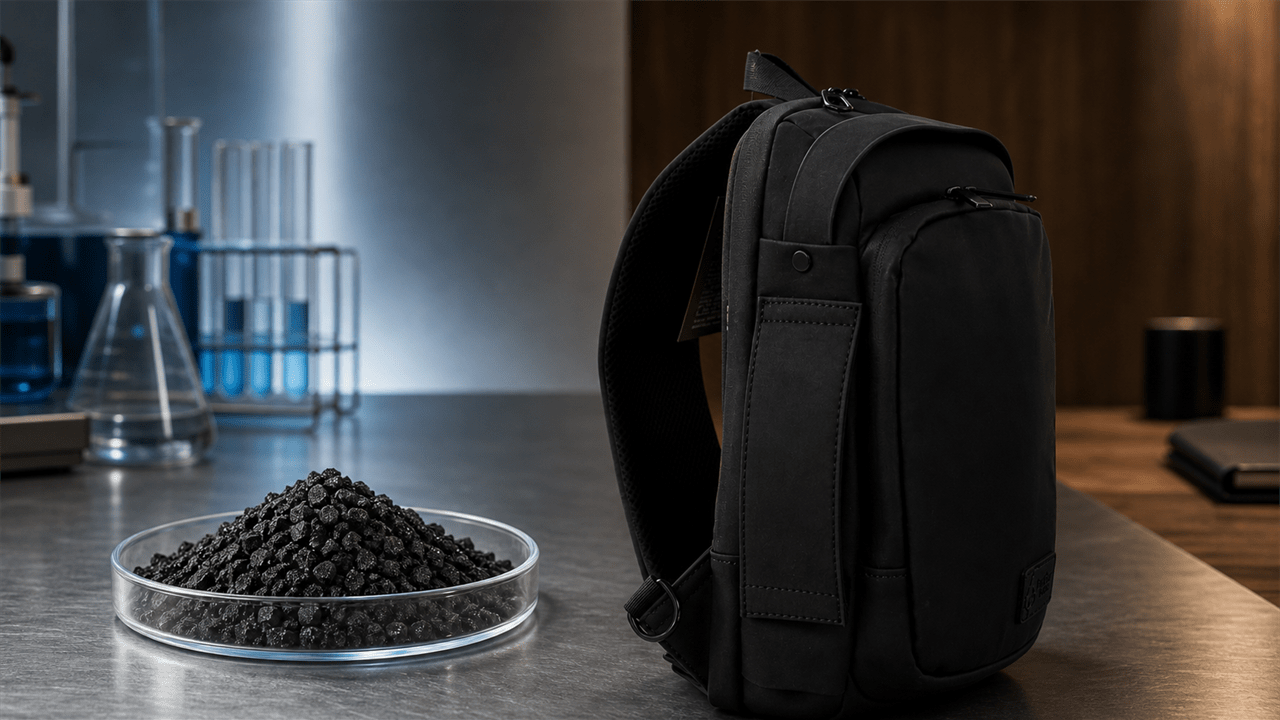
If you're carrying an Executive Tech bag, this is what's inside the lining.
Share:
Continue Reading
Essential vs Executive Tech: Which FireBar Labs Line Is Right for You
Why our bags look like nice bags first