

Texas currently classifies non-delta-9 tetrahydrocannabinols under its controlled-substances schedule. Texas law does not address how an out-of-state purchase, receipt, route, or particular trip affects an individual case.
This page states the Texas classifications and the two separate instruments that landed four months apart in 2026. For the running position on both, the full Texas status summary covers every moving piece.
What the Texas instruments say
Texas republished its controlled-substances schedule as 51 TexReg 4597, effective 2026-07-31 under Tex. Health & Safety Code § 481.034. The operative item exempts only "up to 0.3% delta-9-tetrahydrocannabinols in hemp" as hemp is defined in Tex. Agric. Code ch. 121, then sweeps in the remainder, including "synthetic substances, derivatives, and their isomers with similar chemical structure and pharmacological activity."
The notice never names delta-8, delta-10 or THCP. It works definitionally, and Texas law classifies delta-8, delta-10, THCP and other non-delta-9 isomers as Schedule I. Texas law does not address how an out-of-state purchase or receipt affects an individual case.
What Texas treats as lawful, and what it does not
- Hemp at or below 0.3% total delta-9 THC — measured on a THCA-inclusive basis under 25 TAC §300.101(1) and §300.302(b), sold to adults 21 and over by a registered retailer, with a batch certificate of analysis and a label carrying a route to it (25 TAC §300.402(a), §300.701). CBD, CBG and CBN are untouched by the July notice.
- Delta-8, delta-10, THCP and the other non-delta-9 tetrahydrocannabinols — Schedule I from 2026-07-31 under 51 TexReg 4597.
- THCA flower — effectively out, but under the other instrument. The total-delta-9 measurement in 25 TAC ch. 300 took effect 2026-03-31 and counts THCA toward the 0.3% figure. Different rule, four months earlier, challenged in a different court.
- THC and hemp-cannabinoid vapes — sale prohibited since 2025-09-01 under Tex. S.B. 2024 (2025), a Class A misdemeanor. That statute addresses sale; it is not a possession provision.
The penalty side is where a state line stops being an abstraction. Non-delta-9 tetrahydrocannabinols sit in Penalty Group 2 (Tex. Health & Safety Code § 481.103(a)(1)), and possession of less than one gram is a state-jail felony under § 481.116 — 180 days to two years, and a fine up to $10,000. The detail almost nobody publishes is the counting rule: weight is aggregate, including adulterants. A gummy is weighed as a gummy, not as the milligrams of cannabinoid printed on the wrapper, so a single edible clears one gram comfortably and the grade escalates from there. For what that means for product bought before the schedule changed, see what it means for product already in your possession.
Three things nearly every "driving through Texas" page gets wrong
1. It bundles two instruments into one date. Page after page lists "delta-8, delta-10, THCP and THCA" as a single July 31 event. THCA is not in that group. It is caught by 25 TAC ch. 300, effective 2026-03-31, and the two instruments are on genuinely separate tracks — one is agency rulemaking under appeal in state court, the other a Texas Register notice facing a federal challenge in the Southern District of Texas. As of August 2026, the court had denied temporary emergency relief. The instruments can move independently, and one moving tells you nothing about the other.
2. It reaches for a milligram ceiling that does not exist. Travelers arrive expecting a per-serving or per-container number to stay under, because several other states have one. Texas does not. Nothing in 25 TAC ch. 300 sets one. What the rule does instead is require the certificate of analysis to report the percentage of delta-9 THC, total delta-9 THC and total THC per container (25 TAC §300.301(d)(12)) — a disclosure duty, not a ceiling. Reading a disclosure requirement as a threshold is how a compliant label gets mistaken for a legal allowance.
3. It assumes the federal answer settles the state one. The 2019 federal and Texas hemp definitions (Tex. Agric. Code §121.001) opened the door; the Texas schedule under Tex. Health & Safety Code § 481.034 is a separate layer that Texas moves on its own timetable, and it did. A product can satisfy the current federal hemp definition and still be a Penalty Group 2 substance the moment it is inside Texas. Two layers, two clocks.
The federal layer moves on 2026-11-12 — and it is a separate clock
Section 781 of P.L. 119-37, enacted 2025-11-12, takes effect 2026-11-12 and changes three things at once: the delta-9-only test becomes a total-THC test at 0.3% dry weight, inclusive of THCA and delta-8; finished products get a ceiling of 0.4 mg total THC per container; and cannabinoids not naturally produced by the plant, along with naturally occurring cannabinoids synthesized outside it, drop out of the hemp definition. The Congressional Research Service has published an overview of the redefinition.
Two things about that date are worth holding steady. Section 781 of H.R. 5371, enacted as P.L. 119-37 on 2025-11-12, sets 2026-11-12 as the effective date for the hemp provisions. On 2026-08-08, the Senate passed H.R. 6500 containing proposed one-month partial-delay language; that language was not enacted as part of P.L. 119-37. As of August 2026, the FDA had published neither the anticipated cannabinoid lists nor a definition of “container.” We track the enacted change on the federal change, tracked in one place.
The question we will not answer
Readers send us a version of the same sentence: I have X, I am driving from A to B on Friday, what do I do. We decline it, every time, and the reason is not squeamishness. That question asks someone to apply the law to one person's facts — a specific substance, a specific amount, a specific route, a specific set of circumstances. Doing that is the practice of law, and a bag company is not a law practice.
A Texas-licensed attorney can assess the specific substance, amount, route and circumstances. This article cannot. What this page can do is tell you what the instruments say, when each took effect, and where to read them yourself.
What a bag does on a long drive — and the one thing it does not
Everything above is the law. What follows is what we make, and it stands on its own evidence.
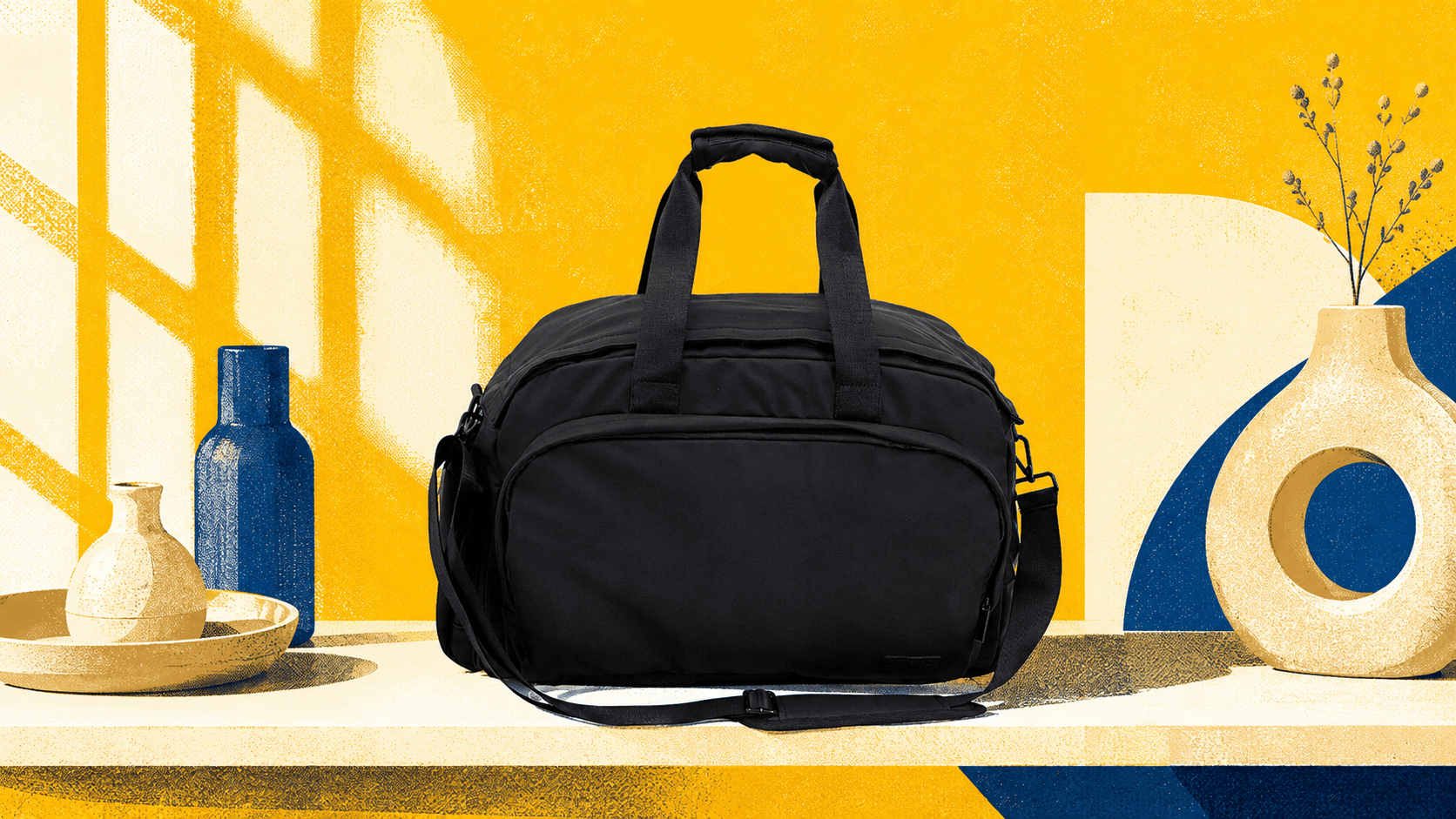
A long drive is a storage problem before it is anything else. Things get hot, crushed, opened, spilled, borrowed and lost in a car shared with other adults for nine hours. A FireBar Labs bag is a container with a job: the whole bag is smell-proof — activated coconut charcoal is built into the bag itself, not tucked into one pocket — and our lockable models carry a hidden anti-hack combination lock, so a bag can be closed and stay closed in a hotel room, a rental, or a friend's kitchen where other people's kids live. Our bags are field-tested in real-world conditions rather than lab-certified. The certificates on our published lab results belong to our consumable products, which are third-party lab tested; they have never belonged to a bag, and we do not claim otherwise.
The Executive Tech line — multi-layered high-performance waterproof vegan leather, not canvas — adds a USB-C pass-through, worth describing precisely because it is usually described backwards. Your own power bank goes inside the bag, and you charge your phone from the port on the outside while the bag stays shut. There is no battery in the bag. On a drive that means power without unpacking at a rest stop. The mechanism, and which models have it, is covered in how the USB-C port works on the road.
Texas law governing hemp and controlled substances focuses on what a product contains and how it is classified, including penalty group and aggregate weight (Tex. Health & Safety Code §§ 481.103, 481.116). A smell-proof bag provides ordinary storage, odor containment, organization, and privacy; any contents remain subject to the laws that apply to them. If what you actually want is the part about encounters, our write-up of your rights at a stop, and what odor actually triggers sets out what Texas appellate courts have held about odor and probable cause, which is not what most of the internet says they held.
Flying is a different question
None of the above travels to an airport. Air travel runs on a different agency and a different rulebook, and it deserves a page rather than a paragraph: flying is a different question — the TSA rules covers screening and what the agency says it is looking for, and traveling for work with hemp products covers hotels, conferences and the awkward middle ground of a business trip.
Which bag suits which trip
Trip shape picks the bag more reliably than trip length does. The FireBar Labs Essential Crossbody Bag ($69.95) is the one that stays on your body through fuel stops and diners. The FireBar Labs Essential Mini Duffle Bag ($59.95) is a weekend of everything in one closed shape. The Executive Tech Hybrid Duffle Bag ($149.00) carries as a duffle or a backpack and is the one with the pass-through port. If you would rather compare numbers than adjectives, the size guide lays out which bag suits which trip by capacity and dimension.
Our bags carry a lifetime warranty against defects in workmanship — not wear, loss or damage — and new, unused product can be returned within 30 days.
Sources and scope
Jurisdiction: the State of Texas and United States federal law. General information, not a substitute for the advice of an attorney.
Information current as of August 2026.
- 51 TexReg 4597 — the republished Texas controlled-substances schedule, and the source of the quoted definitional text
- Texas DSHS controlled-substances schedules — the agency index, for the current published schedules
- Supreme Court of Texas, No. 23-0887 — the 2026-05-01 opinion that unfroze the 2021 definitions
- Congressional Research Service, IF13136 — the federal hemp redefinition arriving 2026-11-12
- Executive Order GA-56 — the 2025 order behind the 21-and-over gate, ID checks, testing and QR labeling now in 25 TAC ch. 300
Frequently asked questions
Does a smell-proof bag change my legal position in Texas?
Texas grades these offenses by penalty group and aggregate weight (Tex. Health & Safety Code §§ 481.103, 481.116), and 25 TAC ch. 300 and 51 TexReg 4597 focus on a product's contents and classification rather than its container. A smell-proof bag provides ordinary storage, odor containment, organization, and privacy; any contents remain subject to the laws that apply to them.
Delta-8 was lawful where I bought it. Does that carry into Texas?
Texas law does not address how an out-of-state purchase or receipt affects an individual case. A Texas-licensed attorney can assess a particular substance, amount, route and set of circumstances.
Is CBD affected?
CBD, CBG and CBN are unaffected by 51 TexReg 4597. The consumable-hemp rules still govern testing, labeling and sales in Texas: 21 and over, registered retailer, and a batch certificate of analysis reachable from the label (25 TAC §300.301, §300.402(a), §300.701).
Did Texas ban THCA on July 31?
No, and this is the most common error on pages about this. THCA flower is effectively out under 25 TAC ch. 300, whose total-delta-9 measurement took effect 2026-03-31 and counts THCA toward the 0.3% figure. That is a different instrument, four months earlier, under challenge in a different court from the July notice. The text of 51 TexReg 4597 does not contain the word THCA.
Is it different if I am only driving through and never stopping?
Texas law does not address how a through-trip or particular itinerary affects an individual case. A lawfully detained driver of a motor vehicle must display a license and identify under Tex. Penal Code § 38.02(b-1), added by S.B. 1551 and effective 2023-09-01. That duty falls on drivers, not on passengers.
What changes on 2026-11-12?
Section 781 of H.R. 5371, enacted as P.L. 119-37 on 2025-11-12, takes effect that day and changes the federal hemp definition: a total-THC test at 0.3% dry weight inclusive of THCA and delta-8, a ceiling of 0.4 mg total THC per container on finished products, and the exclusion of cannabinoids synthesized outside the plant. On 2026-08-08, the Senate passed H.R. 6500 containing proposed one-month partial-delay language; that language was not enacted as part of P.L. 119-37. State schedules are a separate layer and do not move because a federal definition does.
Explore FireBar Labs
- Smell-proof bags with hidden combination locks
- Executive Tech series
- Essential series
- Backpacks
- Crossbody bags
Questions about any of this? Email support@firebarlabs.com — we respond within 24 hours.
Share:
Continue Reading
What a Buyer Must Verify in 2026: COAs, Packaging, Age Checks and the November Cliff
You Bought It Legally. Then Texas Rescheduled It.