

“Lab tested” and “field tested” are both reassuring phrases. They are not interchangeable, and using one where the other belongs makes the evidence sound stronger while telling the reader less. A laboratory test produces measured results under a defined method. A field test asks how a product behaves in ordinary use. One is not automatically better than the other. The right term depends on the product and the question.
FireBar Labs uses both terms because we make two very different kinds of things. Our consumable products are third-party lab tested and have certificates of analysis. Our smell-proof bags and StealthWear apparel are field-tested in real-world conditions. The bags and apparel are not laboratory verified, and we do not present them that way.
The shortest useful distinction
- Laboratory testing measures a defined sample using an identified method and produces a report containing results.
- Field testing puts a finished product into ordinary conditions and observes how it functions as a whole.
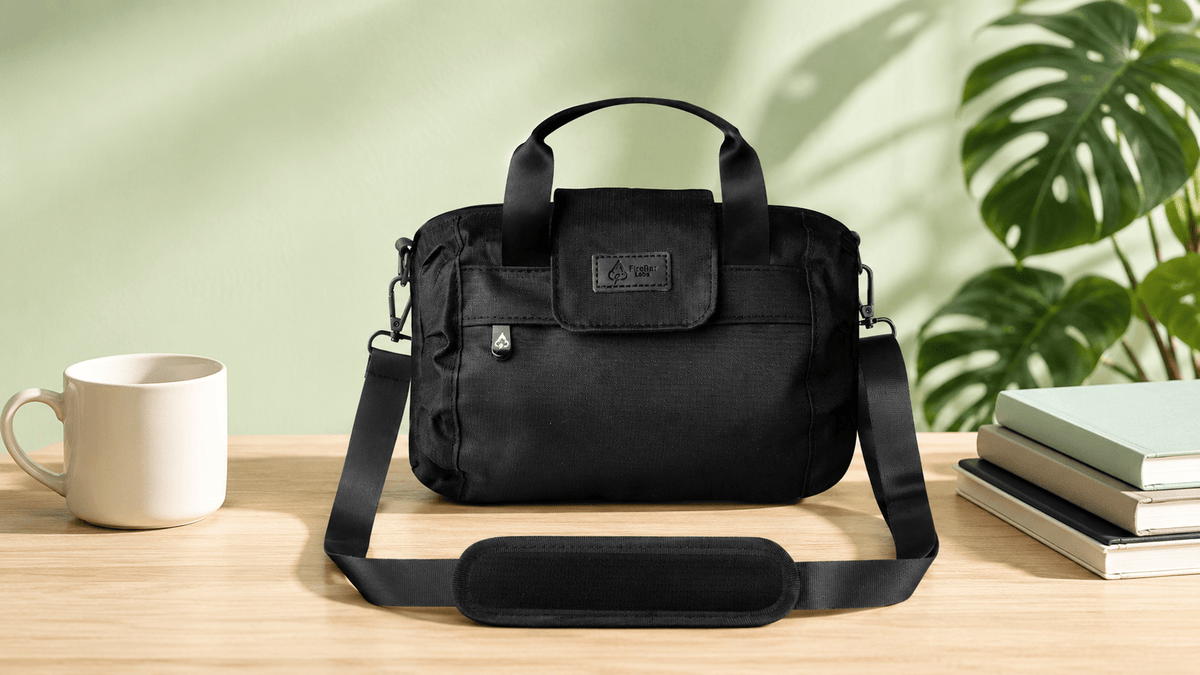
A certificate of analysis can tell a reader what a sample contained when a laboratory tested it. It cannot tell a reader whether the FireBar Labs Essential Crossbody Bag sits comfortably for a day, whether a combination lock is straightforward to live with, or whether a bag format suits a crowded commute. A real-world carry test can answer those usability questions. It cannot produce cannabinoid potency, contaminant results, or a laboratory accreditation.
The categories answer different questions. Trouble starts when copy borrows the authority of one category to decorate a claim from the other.
What “third-party lab tested” means for a consumable
For a consumable product, the sample leaves the brand and goes to an independent laboratory. The laboratory performs an analytical panel and issues a certificate of analysis, usually shortened to COA. The report identifies the sample, the laboratory, the test date, the methods or panels performed, and the results reported for that sample.
The useful word is third-party. The company selling the product is not the company generating the measurements. That separation does not make every report perfect, and it does not make an old or mismatched report relevant to every package. It does create a document that can be inspected rather than a claim that has to be taken on faith.
FireBar Labs publishes results for consumable products on the lab-testing page, organized by product name. Consumable packaging also carries a QR code that opens that product’s lab results. No printed COA document ships inside the box, and reports are not emailed as attachments with an order.
A COA is not a quality adjective. It is a document with a scope. A potency panel reports potency. A contaminant panel reports the contaminants it names. A report says nothing about a test that was not run, and a report for one sample does not silently become a report for a different product. Our guide to what a real certificate of analysis contains covers the document line by line.
What “field-tested” means for a bag
A bag is not a chemical sample. Its useful questions appear while it is being carried, packed, opened, closed, set down, worn, and used again. Field testing places the finished object into those ordinary conditions and evaluates it as an object rather than reducing it to a specimen.
For a smell-proof bag, real-world evaluation can examine the complete system: whether the whole-bag construction contains odor in ordinary use, how the closure behaves when the bag is packed, how the lock fits into a daily routine, and whether the chosen format works for the kind of carry it was designed to handle. Those observations matter because a technically impressive material can still become an awkward bag.
FireBar Labs does not publish a fixed field-test protocol, cycle count, sample size, temperature range, or test duration — “field-tested” is not a laboratory program, and the claim stays exactly as plain as the evidence behind it: the bags are tested in real-world conditions.
That evidence supports real-world language. It does not support “laboratory verified,” “certified odor-proof,” “controlled trials,” or a numeric containment result. Those phrases imply documents and methods that do not exist for the bags.
Why a bag COA would make no sense
A COA is tied to an analytical sample. A finished bag such as the FireBar Labs Essential Mini Duffle Bag contains multiple materials, moving hardware, seams, panels, a closure, and a lock. Its central claim depends on the assembled system. Testing a scrap of charcoal-bearing material would not certify the zipper. Testing the zipper would not certify the seams. A report on one component would be easy to misread as proof about the complete product.
That is why we keep the language at the level the evidence supports. FireBar Labs bags are smell-proof throughout the bag and contain activated coconut charcoal as part of their construction. They are field-tested. They are not lab tested. The four-part containment system explains how the body, charcoal, closure, and handling work together.
Why a field test cannot replace a consumable COA
The reverse substitution is just as weak. Appearance, flavour, texture, or a person’s experience cannot establish the measured cannabinoid content of a consumable. They cannot screen for contaminants or identify a batch. “We tried it” is not analytical evidence.
Consumable products therefore carry the stronger and more specific testing phrase: third-party lab tested. The claim belongs to the documents issued for those products. It does not migrate to bags because the same company sells both, and it does not migrate from one consumable to another without a matching report.
Certificates prove less — and more — than marketing suggests
A laboratory report is powerful because it is narrow. It reports named results for an identified sample. Marketing language often tries to make it universal: “fully tested,” “completely safe,” or “certified clean.” Those phrases erase the scope that makes the document useful.
Reading a report responsibly begins with four matches:
- Product match. The name and form on the report correspond to the product being examined.
- Sample or batch match. The identifying information connects the report to the relevant production sample.
- Date match. The report is current enough to describe the product rather than an earlier formulation or batch.
- Panel match. The document actually contains the result being claimed.
A potency-only report is not a contaminant screen. A report for a different brand is not rescued by similar packaging. A result from an old sample cannot confirm a current batch merely because the product name stayed the same. The certificate is evidence, not atmosphere.
StealthWear belongs on the field-tested side
StealthWear apparel belongs on the field-tested side because the relevant questions concern fit, movement, pocket access, and daily wear. Its construction also differs from a bag in one important way: activated coconut charcoal is in the secret pocket only. The garment as a whole is not described as smell-proof.
That limitation is part of the product definition, not a weakness to hide. A customer comparing a bag with a hoodie needs to know that the bag is a whole-bag odor-containment system while the garment provides a charcoal-lined secret pocket. Using the same broad “smell-proof” sentence for both would collapse two different designs into one inaccurate promise.
Language that matches the evidence
Here is what each phrase on a FireBar Labs product page means — and what it deliberately does not claim.
- Consumable products: third-party lab tested; results available by product name on the lab page and through the packaging QR code.
- Smell-proof bags: field-tested, real-world tested, and smell-proof throughout the bag.
- StealthWear apparel: field-tested; activated coconut charcoal in the secret pocket only.
- What you will not see on bags or apparel: “lab tested,” “laboratory verified,” or “certified odor-proof” — those describe laboratory evidence, and the bags’ evidence is real-world use.
- What you will not see anywhere: blanket phrases like “certified safe” or “tested for everything” — a real certificate covers specific analytes, and an honest label stays inside what its document shows.
This vocabulary is intentionally less dramatic than the version marketing often reaches for. It is also more useful. A reader can tell what was tested, how it was tested, and where the evidence lives.
How the two evidence systems complement each other
A brand that makes both consumables and carry goods needs both systems without blending them. Laboratory reports bring analytical specificity to products that are eaten, applied, or otherwise consumed. Field testing brings whole-object usability to products that are carried, worn, opened, and closed.
The distinction also makes comparison fairer. A bag is judged as a bag rather than as a pretend laboratory sample. A consumable is judged by a document rather than by packaging or testimonial. Each product gets the evidence suited to its actual risks and functions.
Three questions that reveal vague testing copy
Testing language becomes clearer when the claim can answer three questions: what was tested, by whom, and where is the result? For a consumable, the answer points to an identified sample, an independent laboratory, and a COA. For a bag, the answer points to the finished product, real-world use, and the field-tested claim.
Copy that cannot name the object being tested often lets one category borrow from another. “Our products are lab tested” sounds efficient while falsely sweeping bags and apparel into the consumable evidence. “Quality tested” avoids the false detail but gives the reader no evidence at all. Naming the category makes the sentence longer and the claim more honest.
The same test applies to words such as verified, certified, and proven. Each word invites a second noun: verified by what, certified to which standard, proven under which conditions? Where the evidence supplies no answer, the stronger adjective is not available.
What a warranty does not prove
FireBar Labs bags carry a lifetime warranty for workmanship and defects. That promise is about what happens when a covered defect appears; it is not evidence that the bag passed a laboratory test, and it does not cover wear, loss, or damage. A separate 30-day return window applies to new, unused product.
Keeping warranty language apart from testing language matters for the same reason the rest of this page does. A warranty is a remedy. A field test is an evaluation. A laboratory report is a measurement. None becomes another simply because all three can make a buyer feel more confident.
Frequently asked questions
Are FireBar Labs bags third-party lab tested?
No. FireBar Labs bags are field-tested in real-world conditions. Third-party lab testing applies to consumable products, whose results are published by product name on the lab-testing page.
Are all FireBar Labs consumable products lab tested?
Yes. FireBar Labs consumable products are third-party lab tested. The available reports can be reached through the lab-testing page, and consumable packaging carries a QR code that opens that product’s results.
Does a COA prove a product is safe?
A COA reports the panels and results shown on the document for the identified sample. It does not support a panel that was not run, a product that does not match, or a universal claim beyond the report’s scope.
Is StealthWear smell-proof?
The activated coconut charcoal is in the secret pocket only. FireBar Labs does not describe the entire garment as smell-proof. StealthWear is field-tested apparel with a charcoal-lined secret pocket.
What is the difference between a lab test and a controlled trial?
A laboratory test measures a sample under a defined analytical method. A controlled trial is a broader experimental claim involving a protocol and comparison conditions. FireBar Labs does not claim controlled trials for its bags.
Where are FireBar Labs lab results?
They are published by consumable product name at /pages/lab-testing. Packaging QR codes on consumable products provide another route to the same product results. Bags have QR codes for setup instructions, not lab results.
Explore FireBar Labs
Questions about a product claim or a published result? Email support@firebarlabs.com.
Share:
Continue Reading
What "Smell-Proof" Actually Means for a Bag — And What It Doesn't
Five Reasons a Smell-Proof Bag Stops Working (and How to Fix Four of Them)