

“Smell-proof” sounds like a single property: either odor gets out or it does not. A bag is more complicated than that. Odor containment depends on the material, the closure, the seams, and the way the bag is used together. A strong result can be undone by one crumb caught in a zipper or by odor transferred to the outside during packing. The useful question is not whether two words appear on a hangtag. It is what the whole system is designed to do, where that system can fail, and what the maker is willing to claim.
This is the FireBar Labs answer. Our bags are smell-proof throughout the bag, built with activated coconut charcoal and tested in real-world conditions. They are not laboratory-certified odor chambers, and we do not use the vocabulary of a laboratory result for them. That distinction is not fine print. It is the foundation for understanding what a smell-proof bag can honestly promise.
Smell-proof describes a system, not a magic material
Odor does not encounter one obstacle on the way out of a bag. It encounters a sequence. The stored item has its own packaging. The bag surrounds it with odor-managing material. Seams join the panels. A zipper or other closure completes the perimeter. Each part contributes something, and no single part can compensate indefinitely for every other part.
That is why a useful description of a smell-proof bag has four parts:
- Containment. The body of the bag creates a continuous enclosure around what is inside.
- Adsorption. Activated coconut charcoal in the bag provides a large internal surface to which odor molecules can adhere.
- Closure. The opening has to return the enclosure to a closed state every time the bag is used.
- Clean handling. The outside has to remain separate from the residue and oils associated with what goes inside.
FireBar Labs builds the charcoal into the bag construction rather than limiting odor control to a small inner pocket. The whole bag is the smell-proof enclosure. The secret pocket found inside many models has a different job: it is a place for an AirTag or cash. Confusing those two features makes the product sound less capable than it is and describes the construction incorrectly.
What activated coconut charcoal contributes
Activated charcoal is useful because activation creates a network of microscopic pores and a very large internal surface. Odor molecules adhere to that surface through adsorption. The word is easy to misread: adsorption means molecules collect on a surface; absorption means a substance soaks into another material. A towel absorbs water. Activated charcoal adsorbs molecules onto its internal surfaces.
Coconut shell is the carbon source used in FireBar Labs bags. The carbon layer does not perfume the contents, neutralize every molecule chemically, or replace the zipper. It works as one part of the enclosure. The bag body carries that material around the storage space while the seams and closure preserve the boundary.
That difference matters when comparing a purpose-built bag with a regular piece of luggage. A conventional backpack may hide the contents from view, but ordinary fabric and ordinary zippers were not chosen as an odor-management system. A smell-proof bag is designed around the problem from the beginning.
The closure is a working part, not a finishing detail
A bag can have excellent body material and still lose containment at the opening. The zipper follows a long path around the bag, moves every time the bag opens, and collects debris more easily than a flat panel. It is the component most directly affected by hurried packing.
A complete closure means the zipper reaches its end position without fabric, loose material, or an overfilled interior holding the track apart. That statement is mechanical, not ceremonial: a zipper stopped a few millimetres short leaves a different enclosure from a zipper fully seated. Overpacking can put outward pressure on the opening and distort the path the closure is meant to follow.
Locks perform a separate function. FireBar Labs lockable models use a hidden anti-hack combination lock to control access. A lock does not create the charcoal layer and it does not turn an ordinary zipper into an odor filter. It keeps the closure secured against casual opening by children, houseguests, or anyone else who does not have the combination. Odor containment and access control work beside each other; they are not the same claim.
The outside of the bag is outside the system
The most overlooked failure has nothing to do with construction. Material handled during packing can leave odor on fingers, a countertop, or the exterior shell. Once odor is on the outside, the charcoal layer inside the bag is on the wrong side of it. No enclosure can contain residue that was never placed inside the enclosure.
This explains an otherwise puzzling experience: a closed bag appears to smell, yet the source is a zipper pull, handle, or exterior panel touched during packing. The bag may be doing its job around the contents while the surface carries a separate trace. Treating exterior transfer as a distinct problem produces a more accurate diagnosis than assuming the entire bag has failed.
Smell-proof does not mean odor can never exist
Absolute language makes poor product language. “Smell-proof” describes the bag’s designed function under ordinary use. It does not mean a bag can be left open, packed beyond the closure, coated on the outside, damaged, or used forever without care while producing the same result.
It also does not mean every nose, every stored material, every temperature, and every period of use can be reduced to one laboratory number. FireBar Labs bags have not been put through a standardized third-party odor-containment protocol, and we do not claim that they have. They are field-tested and real-world tested. That is a different kind of evidence from the third-party laboratory reports published for our consumable products.
The vocabulary is deliberate. “Third-party lab tested” belongs to a certificate of analysis issued for a consumable product. “Field-tested” belongs to a bag used as a bag. Our full explanation of why we use those two different words on purpose separates the evidence behind each claim.
Smell-proof is not the same as airtight
These terms are often treated as interchangeable, but they describe different things. Airtight is a statement about air exchange under a defined condition. Smell-proof is a statement about odor containment in ordinary use. A charcoal-lined zippered bag can be designed to contain odor without being represented as a hermetically sealed laboratory vessel.
That distinction protects the usefulness of both terms. Calling every odor-containment product airtight stretches a precise word until it stops meaning anything. FireBar Labs describes its bags as smell-proof and does not substitute a more technical claim that the product has not been certified to meet.
Privacy, access control, and odor containment are three jobs
A good bag can address three separate household needs without pretending they are one.
- Odor containment comes from the whole-bag construction, activated coconut charcoal, and a properly closed opening.
- Access control comes from a lockable model and the way the combination is managed.
- Visual privacy comes from ordinary-looking luggage and understated branding.
The FireBar Labs design language does not announce the bag’s purpose from across a room. That is visual discretion, not a claim that the bag makes its contents invisible or changes what they are. A bag is storage. It has no effect on the legal status of anything placed inside it, and it is not a substitute for lawful possession or responsible household access.
What changes between Essential and Executive Tech
The smell-proof job runs across both main FireBar Labs lines. The choice between them is about format, material, and features rather than one line being the “real” smell-proof option.
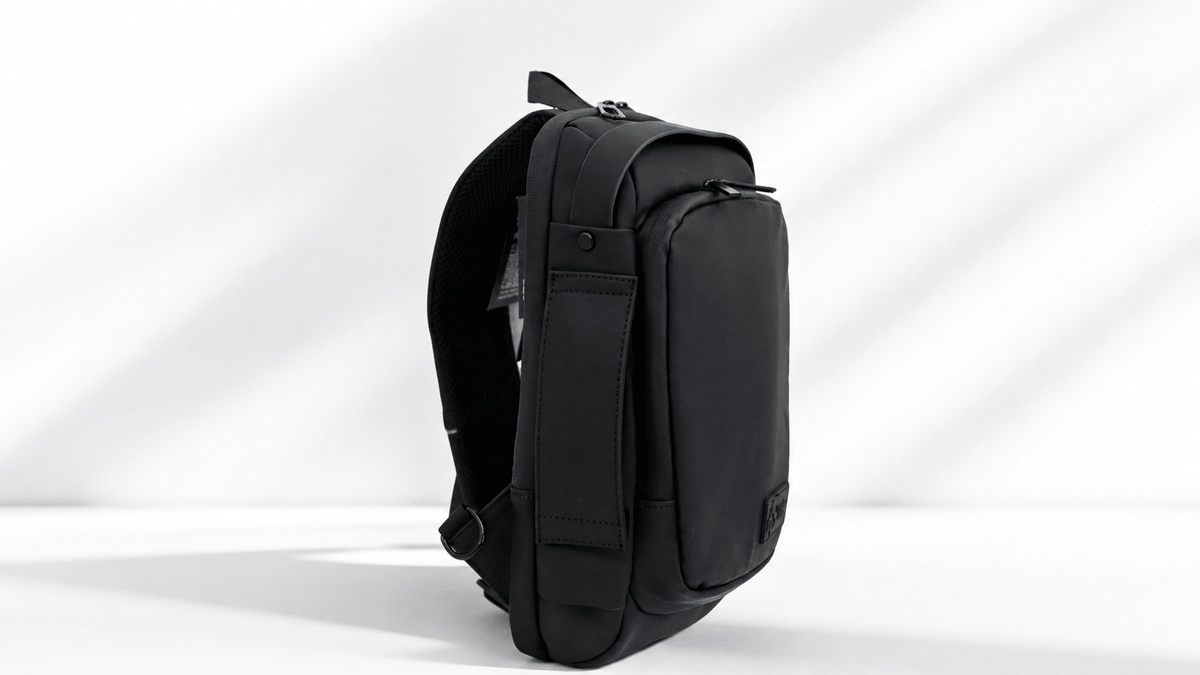
Essential focuses on practical, soft-sided formats, from the compact FireBar Labs Essential Smell Proof Pocket Pouch to the body-worn FireBar Labs Essential Crossbody Bag. The Executive Tech Crossbody and Executive Tech Hybrid Duffle Bag use multi-layered high-performance waterproof vegan leather and add work-and-travel features. Their USB-C pass-through works in one direction: the owner’s power bank goes inside, a phone connects at the outside port, and the bag stays closed. There is no built-in battery.
Both lines are designed as complete smell-proof bags. The size guide compares the formats and verified dimensions, while our line-by-line explanation covers how Essential and Executive Tech differ beyond odor containment.
Where performance can break down
Most loss of performance has a visible mechanical explanation. The bag may be overfilled. The zipper may be obstructed or left short of its end position. Residue may be sitting on the outside. The track, seam, or shell may be damaged. The charcoal system may also be carrying the effects of long use and repeated exposure.
Those causes do not all have the same remedy. Exterior transfer is a surface-cleaning problem. A blocked zipper is a closure problem. Overpacking is a capacity problem. Physical damage is a repair or warranty question. Our diagnostic guide covers what happens when a smell-proof bag stops working without turning every symptom into the same answer.
Routine care lives in a separate guide because maintenance and diagnosis are different jobs. The full cleaning and care routine covers the repeatable process; the diagnostic page starts with the symptom and works backward to the likely cause.
What FireBar Labs does and does not claim
Clear limits make the positive claim stronger, not weaker.
- We describe the whole bag as smell-proof, not one pocket.
- We describe bags as field-tested and real-world tested, not laboratory verified.
- We describe activated coconut charcoal as part of the containment system, not as a magical substitute for a closed zipper.
- We describe lockable models as access-controlled, not unbreakable.
- We do not describe the bags as airtight, hermetically sealed, or certified to a laboratory odor standard.
- We do not claim that storage changes the nature or status of what is stored.
FireBar Labs bags carry a lifetime warranty covering workmanship and defects. That warranty does not cover wear, loss, or damage, and it is not a lifetime return policy. New, unused products fall under a separate 30-day return window.
Size changes capacity, not the definition
A pocket pouch and a duffle solve different load problems, but the phrase “smell-proof bag” means the same thing across them: the complete bag is the enclosure. A larger bag is not automatically stronger, and a smaller bag is not a lesser version. Capacity changes how much space the closure has to manage and how easily a load can distort it.
This is why choosing a size is part of performance rather than a purely cosmetic decision. A correctly sized bag returns to its intended shape when closed. A bag asked to contain more than its shape allows places pressure on the same zipper path that completes the enclosure. The maintained size guide keeps that decision tied to verified dimensions.
Frequently asked questions
Is the whole FireBar Labs bag smell-proof?
Yes. Activated coconut charcoal is built into the bag construction, so odor containment is a whole-bag feature rather than a property limited to the secret pocket. The secret pocket is intended for an AirTag or cash.
Are FireBar Labs bags lab tested?
No. The bags are field-tested in real-world conditions. Third-party laboratory testing and certificates of analysis apply to FireBar Labs consumable products, not to bags or StealthWear apparel.
Does activated charcoal absorb odor?
The precise term is adsorption: molecules adhere to the charcoal’s internal surfaces. The charcoal works with the bag body, seams, and closure as one containment system.
Is a smell-proof bag airtight?
Not by claim. “Airtight” is a technical statement about air exchange, while “smell-proof” describes the designed odor-containment function in ordinary use. FireBar Labs does not represent its zippered bags as hermetically sealed vessels.
Why can odor appear around a closed bag?
Common causes include an incomplete or obstructed closure, overpacking, residue transferred to the exterior, or physical damage. The location and timing of the odor help separate a handling issue from a closure or construction issue.
Does the lock make the bag smell-proof?
No. The lock controls access. The whole-bag construction, charcoal layer, seams, and closure perform the odor-containment job. The two features work together but make different promises.
Explore FireBar Labs
- The full FireBar Labs smell-proof collection
- Essential series
- Executive Tech series
- Pocket pouchs
- Duffle bags
Questions about bag construction or care? Email support@firebarlabs.com.
Share:
Continue Reading
Hemp Business Compliance Guide: Navigating the November 2026 Intoxicating Hemp Ban & State-Level Changes
"Lab Tested" and "Field Tested" Are Not Synonyms